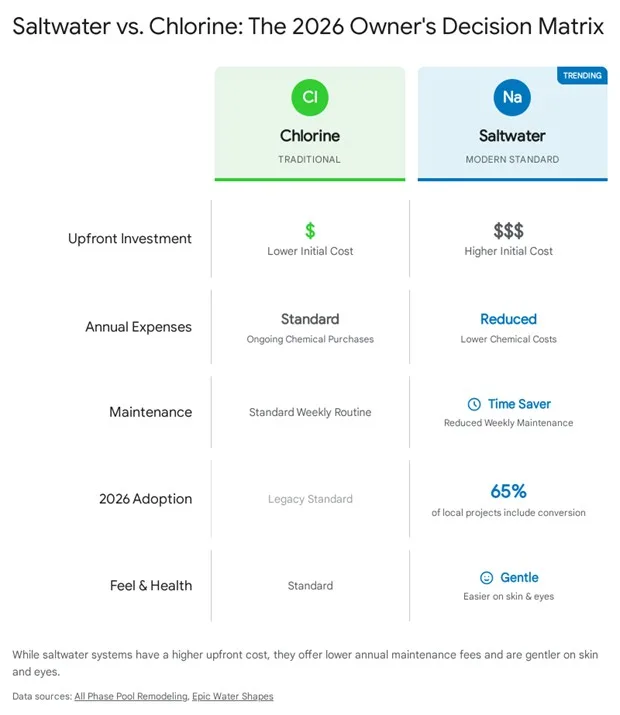
More Jacksonville homeowners are making the switch to saltwater pools in 2026, and it's easy to see why. Saltwater systems are gentler on skin, easier to maintain week-to-week, and cost less to operate over time. If you're weighing the switch, this guide breaks down everything you need to know, from how these systems actually differ to what conversion will cost you here in Northeast Florida.
Ready to explore your options? Call All Phase Pool Remodeling, Inc at (888) 714-7665 for a free estimate today.
How Does a Saltwater Pool Actually Work?
A saltwater pool doesn't eliminate chlorine. It generates it. A salt chlorine generator (also called a salt cell) converts dissolved salt into chlorine through a process called electrolysis. The result is a steady, low-level supply of chlorine, rather than the sharp spikes you get when manually dosing a traditional pool.
Traditional liquid chlorine pools rely on you, or your pool service, to add chlorine regularly. Miss a treatment during a hot Jacksonville summer, and your water chemistry can swing fast. Saltwater systems handle that automatically, keeping levels consistent with far less hands-on effort.
What Are the Real Benefits of Switching to Saltwater?
The skin and eye comfort difference is noticeable right away. Saltwater pools typically run at chlorine levels of 1-3 ppm, compared to 2-4 ppm in traditionally chlorinated pools. That lower, steadier concentration is what makes saltwater feel softer and reduces the red-eye and skin irritation that many swimmers associate with chlorine.
For Jacksonville families who use their pools frequently from March through October, that comfort difference matters. Homeowners in neighborhoods like Ponte Vedra Beach and Riverside report that the softer water feel alone is enough reason to convert.
Beyond comfort, here's what most homeowners care about:
- Reduced chemical costs: Most saltwater pool owners spend $70-$100 per year on salt, versus $300-$800 per year on liquid chlorine and chemical balancers
- Less maintenance time: No weekly chlorine runs to the pool supply store
- Fewer chemical fluctuations: Consistent chlorine output means fewer algae outbreaks
- Better for surfaces and equipment: Stable chemistry reduces wear on your pool finish over time
Are There Downsides to Saltwater Pools?
Yes, and they're worth knowing before you commit.
The salt cell itself is the main vulnerability. Most cells last 3-7 years and cost $200-$700 to replace. Salt water is also slightly corrosive over time, which means certain metal components, including ladders, light fixtures, and some pump hardware, may wear faster than in a traditionally chlorinated pool.
If you're also planning pool resurfacing in Jacksonville, Florida, now is a smart time to discuss which finish materials hold up best against saltwater chemistry. Pebble Tec and quartz aggregate finishes perform significantly better in saltwater environments than standard plaster, which can degrade faster when salt levels aren't precisely maintained.
One more thing most pool companies won't volunteer: saltwater pools still require regular water testing. Salt doesn't manage pH, alkalinity, or calcium hardness. Those still need monitoring every 1-2 weeks.
How Do You Convert a Chlorine Pool to Saltwater?
Converting a traditional chlorine pool to saltwater in Jacksonville takes 1-3 days for most residential pools. Here's what the process looks like:
Step 1: Assess your current equipment
Not all existing pumps, filters, and heaters are compatible with salt systems. A pool technician checks your equipment and identifies anything that needs upgrading before installation.
Step 2: Select and install the salt chlorine generator
The generator mounts inline with your existing plumbing. Brands like Hayward and Pentair offer reliable units in the $500-$1,500 range for residential pools. Higher-end models include automation controls and self-cleaning cells.
Step 3: Add pool-grade salt
Most pools need 50 lbs of salt per 2,000 gallons to reach the target salinity of 3,000-3,500 ppm. For an average 15,000-gallon pool, that's roughly 375 lbs of salt, costing around $75-$100 for the initial fill.
Step 4: Balance water chemistry
Before turning on the salt cell, your technician balances pH (target: 7.4-7.6), alkalinity (80-120 ppm), and calcium hardness (200-400 ppm). Getting these right from the start protects your new equipment and your pool surface.
Step 5: Commission and test the system
The generator runs through its startup cycle, and your technician confirms it's producing chlorine at the correct output level. Most systems take 24-48 hours to fully stabilize.
If your pool surface is already deteriorating, pairing this conversion with professional pool resurfacing makes sense. Starting fresh with a new finish and a new sanitation system means you're protecting both investments from day one.
Why Does Jacksonville's Climate Make Saltwater a Smarter Choice?
Northeast Florida's heat and sun load are hard on any pool sanitation system. Jacksonville averages over 230 sunny days per year, and UV rays from direct sunlight break down free chlorine rapidly. In a traditional chlorine pool, that means constantly fighting against chlorine loss, especially in summer.
Saltwater systems continuously replenish chlorine as it's consumed, which makes them far better suited to Jacksonville's long swim season and intense UV exposure. We see this with pools in Orange Park and along the St. Johns River waterfront, where sun exposure is high and pools get heavy use from May through September.
Salt is also less affected by Florida's frequent rain. A thunderstorm that dilutes your pool doesn't throw off a saltwater system nearly as dramatically as it would a manually dosed chlorine pool.
If your pool is due for a full pool renovation, combining a saltwater conversion with updated equipment and a fresh surface is one of the most cost-effective ways to get more years out of your pool with less maintenance overhead.
What Does Saltwater Pool Conversion Cost in Jacksonville?
Here's a realistic breakdown for Jacksonville homeowners in 2026:
Item | Estimated Cost |
Salt chlorine generator (installed) | $800 - $2,000 |
Initial salt fill (15,000-gallon pool) | $75 - $150 |
Water chemistry balancing | $50 - $150 |
Compatible equipment upgrades (if needed) | $200 - $1,000+ |
Total conversion cost | $1,125 - $3,300 |
The payback timeline for most Jacksonville homeowners runs 2-4 years. After that, the $200-$700 in annual chemical savings adds up quickly. Over 10 years, switching to saltwater can save $2,000-$7,000 in chlorine and chemical costs alone.
A note on timing: local conversion project volume in Northeast Florida has increased by 65% over the past few years, which means scheduling earlier in the season gets you better availability and sometimes better pricing. Spring (February through April) is the ideal window to convert before swim season fully kicks in.
If your pool also needs pool resurfacing in Jacksonville, Florida, bundling both projects cuts down on labor costs and pool downtime significantly.
Ready to Make the Switch?
Saltwater conversion is one of the best investments a Jacksonville pool owner can make in 2026. Lower chemical costs, softer water, less hands-on maintenance, and a sanitation system built for Florida's long, hot summers all add up to a pool that's genuinely more enjoyable to own.
All Phase Pool Remodeling, Inc. has been serving Jacksonville and Northeast Florida since 1993. Our team handles salt system installation, pool resurfacing in Jacksonville, Florida, equipment upgrades, and full pool renovations, all under one roof with no subcontractors for resurfacing work.
Call (888) 714-7665 or request your free estimate online today. Our team will assess your pool, walk you through your options, and give you a clear, written quote with no surprises.