If your pool was built in the 1990s and you've been patching it every season, you're likely spending more money than a full resurfacing would cost. Orlando, Florida homeowners with aging pool surfaces face a tough decision: keep patching or commit to a proper fix. This post breaks down exactly why the patch-and-pray approach backfires, what it costs, and how to know when it's time to stop throwing money at a surface that's past its prime.
Ready to stop guessing? Call All Phase Pool Remodeling, Inc. at (888) 714-7665 for a free on-site estimate.
Why Do 1990s Pool Finishes Keep Failing?
Standard plaster applied in the 1990s has a lifespan of 5 to 10 years. If your pool is 25 to 30 years old, that surface has been chemically saturated, sun-baked, and structurally compromised for over a decade past its intended life. Patches don't bond the same way to aged plaster as they do to fresh material. The new patch shrinks and expands at a different rate than the surrounding surface, which means you'll see it fail again, usually within 12 to 18 months.
Most homeowners in areas like Dr. Phillips and MetroWest don't realize that the plaster isn't just cosmetic. It's a protective layer. Once it deteriorates past a certain point, the underlying gunite shell becomes exposed to water and chemicals, and that's when repair costs climb fast.
What Does Repeated Patching Actually Cost?
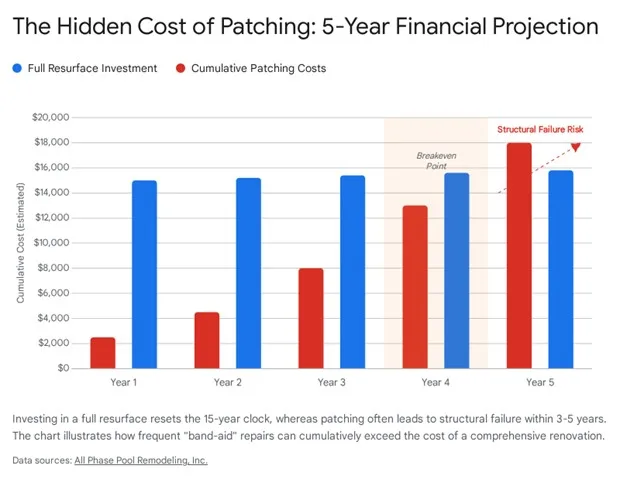
Each patch job on a residential pool typically runs between $200 and $800, depending on the size of the affected area and the contractor. Apply that two or three times a year, and you're looking at $400 to $2,400 annually. Over five years, that's up to $12,000 spent on temporary fixes that do nothing to address the root cause.
Compare that to a full pool resurfacing, which starts at around $5,000 for standard plaster and goes up to $18,000 or more for premium Pebble Tec finishes. A quality resurface resets the clock, giving you another 10 to 20 years depending on the material you choose. The math isn't complicated.
Beyond the direct repair bills, there's the water loss to factor in. A pool with a deteriorating surface often develops slow leaks. Losing even a quarter-inch of water per day adds up to thousands of gallons monthly, which hits both your water bill and your pool chemical costs.
What Are Hollow Spots and Why Do They Matter?
Hollow spots are sections of plaster that have separated from the gunite shell underneath. You can find them by tapping the pool surface with a coin or a screwdriver handle. A solid bond produces a dull thud; a hollow spot produces a hollow, higher-pitched knock.
This matters because water gets behind those delaminated sections and continues working against the structure. In Orlando's climate, where pools are used almost year-round and water chemistry fluctuates with summer rains and high temperatures, hollow spots grow quickly. Patching over them traps moisture and accelerates the breakdown. We see this frequently on pools that have been maintained by rotation of different service companies, where no single contractor has a clear picture of what's happening beneath the surface.
Ignoring hollow spots doesn't just mean a bad-looking pool. It can mean structural repairs to the gunite shell itself, which pushes project costs significantly higher, sometimes into the $5,000 to $15,000 range for shell work alone.
How Does Florida's Climate Affect Pool Surfaces?
Orlando's combination of intense UV exposure, 90°F+ summers, and frequent afternoon thunderstorms creates conditions that accelerate surface wear faster than most of the country. Pools here don't get a winter break. They run year-round, which means the surface is under constant chemical and thermal stress.
Traditional plaster is particularly vulnerable. It's porous, absorbs chemicals, and reacts to pH swings. Florida's water chemistry also varies significantly by area. Homes in parts of east Orange County deal with harder water, which causes calcium buildup and accelerates plaster erosion. Modern materials handle these conditions far better.
Quartz aggregate finishes like Diamond Brite last 10 to 15 years and resist chemical damage far better than plain plaster. Pebble Tec and similar pebble finishes last 15 to 20-plus years and are specifically engineered for high-use, high-exposure environments. For a full pool renovation in a Florida climate, pebble finishes are consistently the best long-term value.
How Do You Know When Patching Won't Cut It Anymore?
Six signs tell you the surface is beyond a simple patch job:
- Rough texture across large areas, not just isolated spots. If the surface snags swimsuits or scrapes feet in multiple places, the plaster has reached widespread deterioration.
- Stains that won't respond to acid washing. Permanent staining means the plaster has absorbed minerals and chemicals at a structural level.
- Visible cracks running more than a few inches, especially if they reappear after patching. These often indicate underlying gunite movement.
- Multiple hollow spots spread across the floor or walls. One or two isolated spots can be repaired. Widespread delamination means the bond coat has failed.
- Recurring water loss beyond the normal half-inch per day from evaporation. If a bucket test confirms your pool is losing more than that, the surface is contributing to leaks.
- Patches from previous repairs that are visibly mismatched and beginning to fail. If your pool looks like a patchwork quilt, it's past the point of cosmetic fixes.
In our experience serving Winter Park, Dr. Phillips, and communities across Central Florida, pools that have hit three or more of these signs are always cheaper to resurface than to keep patching. The only question is how long a homeowner waits before making that call.
What Materials Hold Up Best for Pool Renovation in Orlando, Florida?
For pool renovation in Orlando, Florida, the right material depends on your budget, usage, and how long you plan to stay in the home.
Standard plaster is the most affordable at $5,000 to $10,000, but its 5 to 10-year lifespan makes it the most expensive per year over time. It's a reasonable choice if you're preparing a home for sale and need a clean surface without a large investment.
Quartz aggregate (Diamond Brite and similar products) sits in the middle range and lasts 10 to 15 years. It handles Florida's water chemistry better than plaster and comes in a wide range of colors.
Pebble Tec and pebble finishes are the top choice for homeowners planning to stay in their homes long-term. They're more resistant to staining, hold up to Florida's UV exposure, and carry manufacturer warranties when installed by certified applicators. All Phase Pool Remodeling, Inc. is PTI certified, meaning Pebble Tec installations come with the full manufacturer warranty.
Glass bead finishes are a premium option that creates a striking visual effect and lasts 15 to 20 years. They're popular in newer builds around Lake Nona and in higher-end Dr. Phillips properties where aesthetics are a priority alongside durability.
Stop Patching and Start Planning: Get Your Free Estimate
A 1990s pool surface in Central Florida has almost certainly reached the end of its useful life. Every patch applied to aged, delaminated plaster is money spent delaying the inevitable, and that delay comes with real costs: higher water bills, escalating chemical use, growing structural risk, and a backyard that doesn't look or feel the way it should.
A proper resurfacing doesn't just fix the problem. It resets the timeline, protects your property value, and gives you a pool you'll actually want to use. For homeowners weighing pool renovation in Orlando, Florida, the return on investment from a quality resurface is consistently stronger than continuing with patchwork repairs.
Contact All Phase Pool Remodeling, Inc. at (888) 714-7665 to schedule your free consultation. Their team has been serving Orlando and Central Florida since 1993, with thousands of completed renovations and in-house plaster crews who don't cut corners.